Qwen3.8-LiveTranslate Cuts Real-Time Interpretation Lag to 2.3 Seconds Across 60 Languages
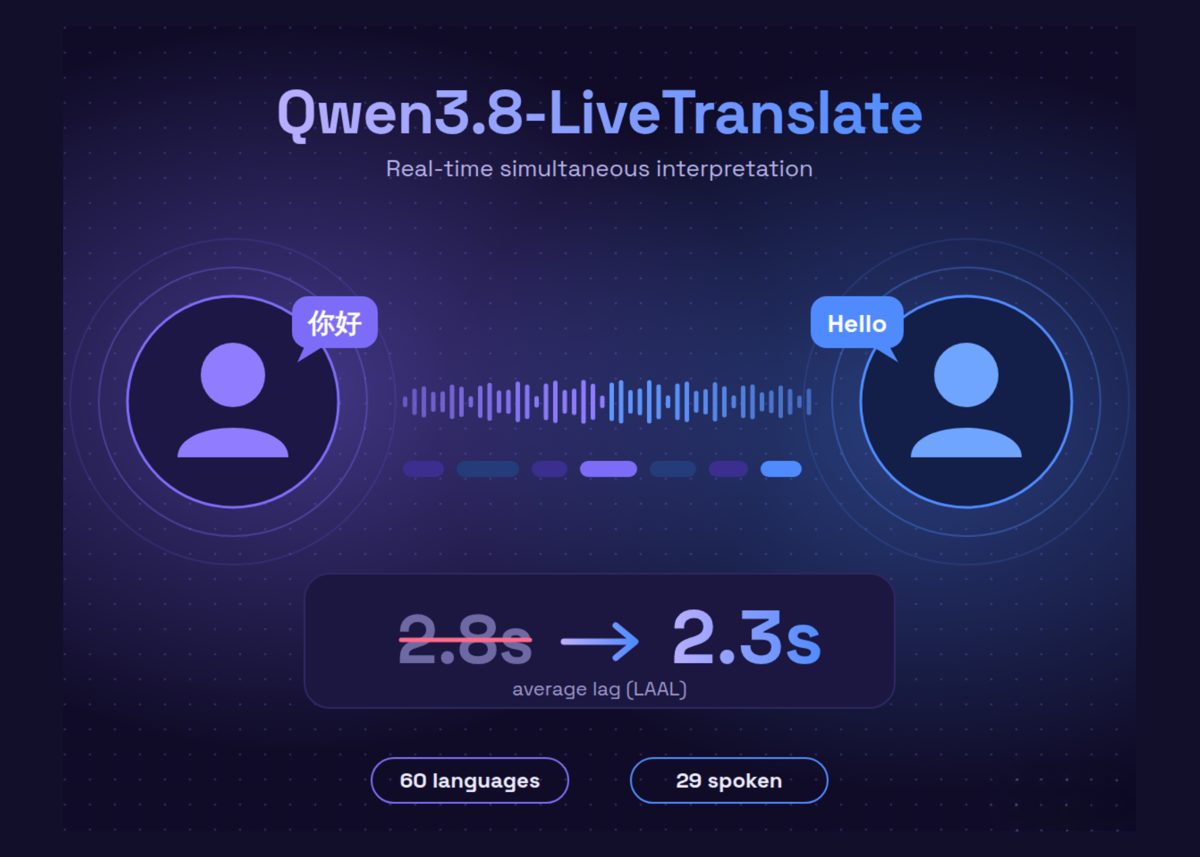
Qwen3.8-LiveTranslate targets the hardest problem in machine translation — doing it live. By cutting average end-to-end lag to 2.3 seconds across 60 languages, it aims at the simultaneous-interpretation use case (meetings, broadcasts, cross-border calls) where latency, not just accuracy, determines whether a tool is usable.
The 2.3-second figure is the key metric: human simultaneous interpreters operate with a few seconds of lag, so a model in that range starts to feel conversational rather than stilted. Achieving it across 60 languages implies a streaming architecture that begins translating before a sentence completes, balancing the accuracy-latency tradeoff that trips up naive chunked approaches.
LiveTranslate is the third leg of Alibaba's release burst this week, complementing Omni-Flash's 74-language speech recognition and 29-language generation, and the open-weight Qwen-Image-2.1. Together they show Qwen attacking multilingual and multimodal capability aggressively, pressuring Google Translate, OpenAI's real-time voice, and specialized interpretation vendors on both breadth and speed.
The skeptical view is that latency and accuracy are in tension — a 2.3-second lag is impressive only if translation quality holds, and vendor-reported figures rarely capture noisy, accented, domain-specific real-world speech. Independent evaluation across language pairs and audio conditions is needed. Watch for API pricing (given Omni-Flash's aggressive cuts) and third-party benchmarks on translation fidelity, not just speed.