NVIDIA Ships Synthetic Video Detector NIM and Nemotron 3 Ultra Agent Model
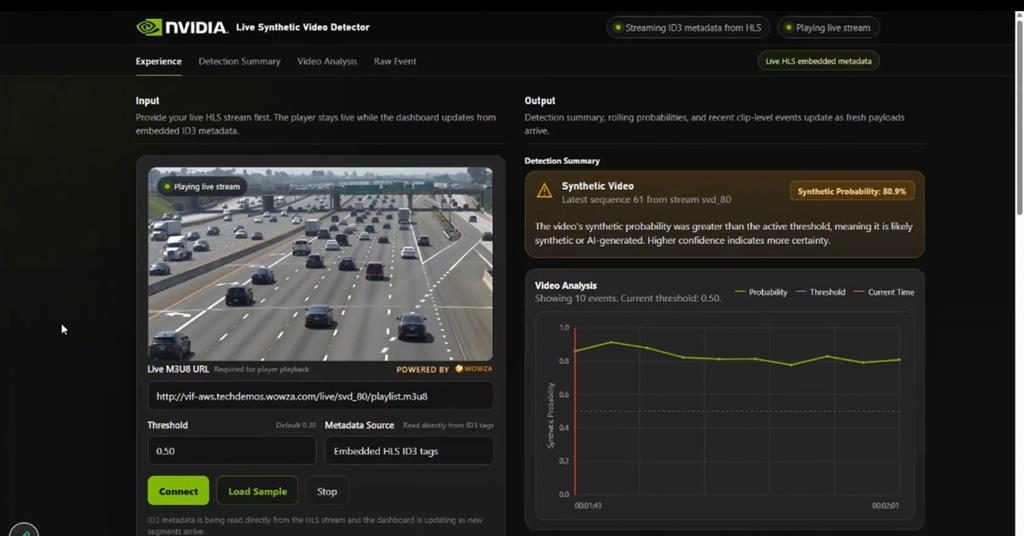
NVIDIA released a Synthetic Video Detector NIM microservice under its NVIDIA For Media platform, a tool that analyzes video frame-by-frame to flag AI-generated or manipulated footage. It reaches up to 92% accuracy and — critically for real-world newsroom use — survives the compression, resizing, and re-encoding that normally degrade detection reliability. As deepfake video quality rises, robust detection that holds up through distribution pipelines is increasingly essential for media organizations.
Alongside it, NVIDIA debuted Nemotron 3 Ultra, positioned for top-tier AI agent tasks and available via NVIDIA NIM and as downloadable Hugging Face weights. This extends NVIDIA's open Nemotron model family — first broadly unveiled at GTC 2026 — into the agentic reasoning space, giving developers a high-throughput open model optimized for NVIDIA hardware. The dual distribution (managed NIM plus open weights) mirrors the industry pattern of offering both a hosted service and self-deployable weights.
Strategically, NVIDIA is layering software and models on top of its hardware dominance, capturing more of the AI stack than just GPUs. The Synthetic Video Detector, in particular, positions NVIDIA in the content-authenticity and media-integrity market — a growing category as synthetic media proliferates and as newsrooms, platforms, and regulators seek reliable detection.
For readers, these are incremental but telling releases: NVIDIA doesn't need to win the model race to profit from it, but shipping competitive open agent models (Nemotron 3 Ultra) and specialized tools (video detection) deepens its platform lock-in and diversifies revenue beyond chips. The watch item on the detector is real-world false-positive/false-negative rates outside NVIDIA's benchmarks — 92% accuracy is meaningful but leaves substantial error room for high-stakes newsroom verification, where a single missed deepfake or false flag carries reputational cost.