AWS Network Firewall drops IP bookkeeping: rules can now target VPCs, subnets and security groups
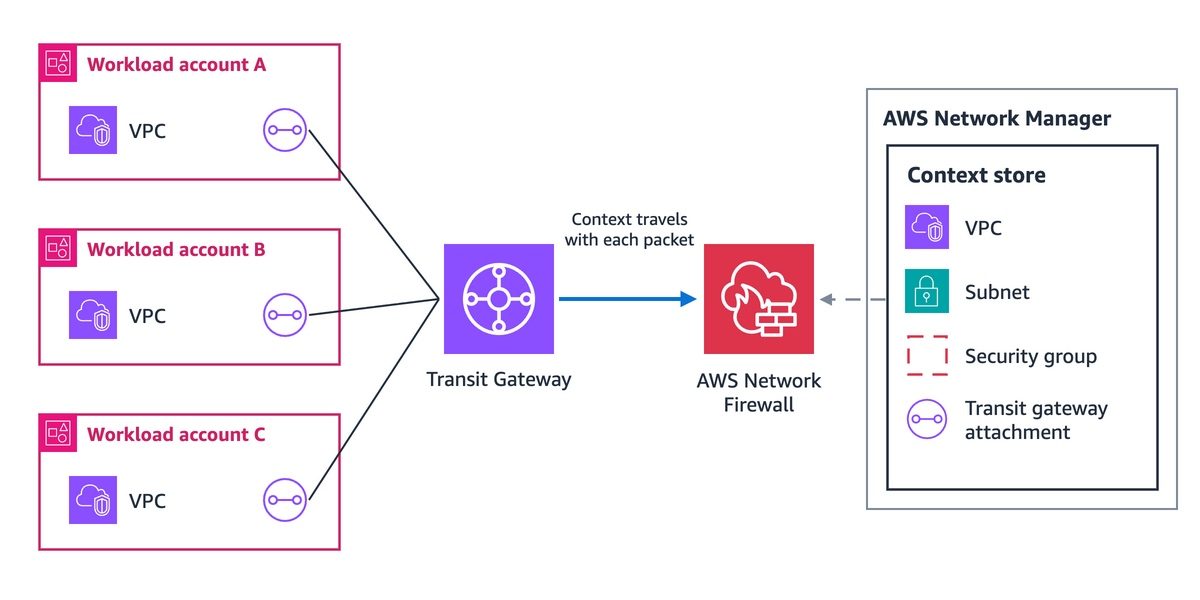
AWS has introduced context-aware rules for AWS Network Firewall. Security teams can now write rules whose sources and destinations are AWS constructs (a VPC, a subnet, a security group, or a transit gateway attachment) rather than CIDR blocks. In practice, a rule such as 'allow the app-tier security group to reach the database subnet' keeps working as instances scale, IPs churn, or new subnets appear, with no manual rule updates.
Under the hood, the firewall resolves those references against live infrastructure state. That removes a familiar class of drift bug, where an autoscaled fleet picks up addresses the firewall policy never anticipated and traffic is silently dropped or, worse, over-permitted because someone widened a CIDR to stop the pages. Security groups already work this way inside a VPC. Context-aware rules bring the same identity-style addressing to the centralized inspection layer, which in many organizations sits in a separate inspection VPC behind a transit gateway.
The release is part of a broader Network Firewall push this week. AWS separately introduced a Next Generation policy type that combines least-privilege allow rules with managed stateful IDS/IPS inspection of every allowed connection, and an automated internet firewall mode in preview that applies central rules at each VPC's internet gateway with built-in NAT. Taken together, AWS is trying to make its native firewall competitive with third-party appliances from Palo Alto, Fortinet and Check Point, which have long offered object-based policies. It also matters for agentic workloads: as teams spin up sandboxes and agent runtimes dynamically, IP-pinned rules become harder to maintain.
What to watch: the pricing of rule evaluation at scale, how quickly references resolve when resources change (any lag is a window of mis-enforcement), and support in CloudFormation and Terraform so rules can live in code. Teams with large IP-set inventories should treat migration as a gradual project and audit for rules that depended on broad ranges by accident.
