NVIDIA ships TensorRT Model Connect in public preview: Hugging Face checkpoint to native C++ in two commands
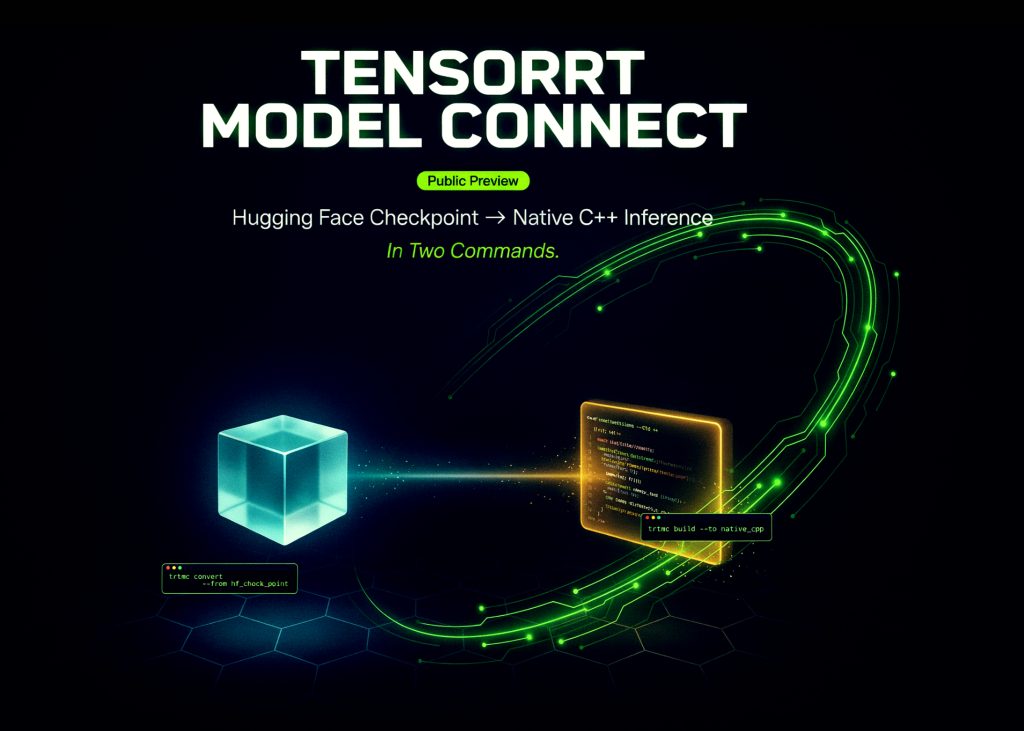
TensorRT Model Connect targets one of the most persistent friction points in production ML: turning a research checkpoint into optimized, deployable inference. NVIDIA says a supported Hugging Face model or a local checkpoint can be taken to end-to-end TensorRT inference in just two commands, eliminating the traditional ONNX export step that has long been a source of conversion bugs and compatibility headaches.
The resulting artifact is a bundle that runs through native C++ APIs, making it directly usable in the low-latency, resource-constrained environments — edge devices, embedded systems, and high-throughput services — where Python overhead and multi-step conversion pipelines are painful. NVIDIA AI's official account emphasized the two-command workflow and the removal of the intermediate export, and said the entire project was built to be accessible to developers.
Strategically, the release deepens NVIDIA's grip on the deployment layer of the stack. By making it trivial to go from the open-model ecosystem (Hugging Face) straight to optimized NVIDIA inference, the company reduces the temptation to optimize for alternative accelerators and reinforces CUDA/TensorRT as the default path for shipping models.
The caveats: 'supported' models are a gating factor, and native C++ bundles trade portability for performance. It also arrives alongside NVIDIA's other developer tooling this week — the ALCHEMI materials-simulation toolkit and multi-GPU UMAP — signaling a broader push to court AI coding agents and practitioners. Watch how wide the model-support matrix is at GA and whether the two-command promise holds for larger, more exotic architectures.