NVIDIA releases Nemotron 3 Diarization model with 14.72% error rate
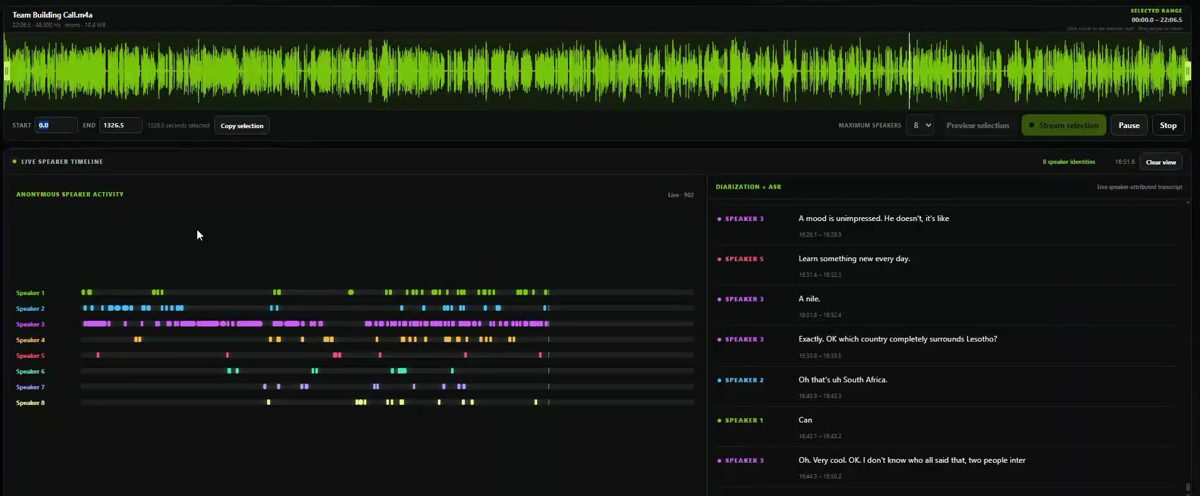
NVIDIA's Nemotron 3 Diarization is a compact 100M-parameter model focused on speaker diarization — identifying who spoke when in multi-speaker audio. It ranks #1 on Voicearena AI's Diarization-Bench with a 14.72% error rate, roughly 24% lower than the runner-up, and can handle up to eight overlapping speakers, a notably hard case for diarization systems.
The model's small size is part of the pitch: at 100M parameters it's practical to deploy for real-time transcription, meeting analytics, and voice-agent pipelines without heavy compute. NVIDIA released it on Hugging Face, and the launch was paired with related ecosystem work including Pollen Robotics' Reachy Mini and DGX Spark.
The timing is quietly ironic — NVIDIA shipped an open model on Hugging Face the same week it agreed to acquire the platform for $13B, a juxtaposition that will draw attention given developer fears about the hub's future neutrality. It also underscores NVIDIA's steady expansion beyond chips into models and developer tooling, of which the Hugging Face acquisition is the capstone.
Diarization is a narrow but commercially important capability, feeding transcription, call-center analytics, and multi-speaker voice agents. A specialist model that leads a public benchmark at small scale is a credible practitioner tool rather than a headline frontier release. The main caveat is that Diarization-Bench leadership is one benchmark; real-world audio (noise, accents, crosstalk) is harder than curated test sets. Developers will judge it on production performance, and its Hugging Face availability makes hands-on evaluation easy.