NVIDIA's Jetson Orin Nano 2 doubles edge inference for robotics
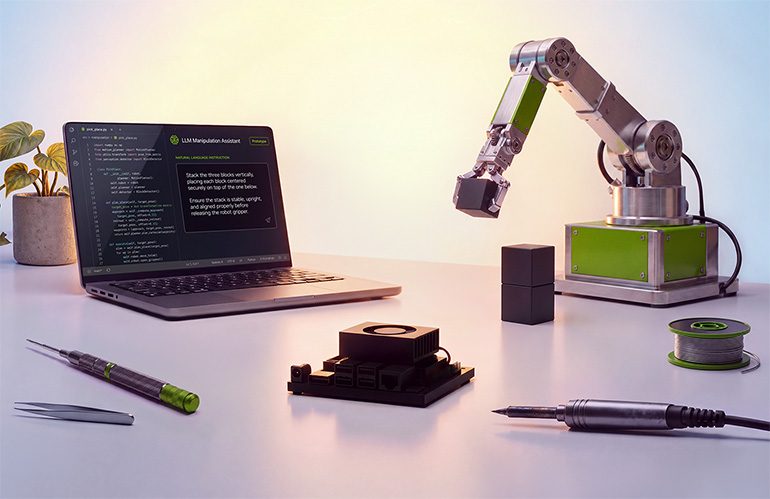
NVIDIA introduced the Jetson Orin Nano 2, claiming it doubles inference performance for edge robotics and enables frontier LLMs and vision-language models to run directly on-device atop existing autonomy stacks. Executive Deepu Talla framed it as the realization of a decade-long dream for edge AI — bringing large-model capability out of the datacenter and onto robots and embedded systems.
The technical pitch centers on running perception, reasoning, planning, and action locally, reducing dependence on cloud round-trips for latency-sensitive robotics. That matters for autonomous machines that must react in real time and operate with intermittent connectivity, and it dovetails with NVIDIA's broader physical-AI stack — Cosmos world models, Isaac robotics, and Omniverse simulation — that Amazon just committed to adopting for its robot fleet.
The Orin Nano 2 also comes in a more accessible variant aimed at robotics developers and hobbyists, extending NVIDIA's grip on the edge-AI developer ecosystem the way CUDA locked in datacenter developers. It arrives the same week NVIDIA's cloud dominance is being challenged by OpenAI's Jalapeño inference chip, underscoring that NVIDIA is fighting on two fronts — datacenter and edge.
The practical questions are power envelope, price, thermal constraints, and which model sizes realistically run on-device versus which still require cloud. Watch for developer benchmarks on real robotics workloads and whether 'frontier LLMs on the edge' holds up beyond marketing for anything larger than compact VLMs.