NVIDIA introduces ASPIRE self-improving robotics framework, hits 31% zero-shot on LIBERO-Pro
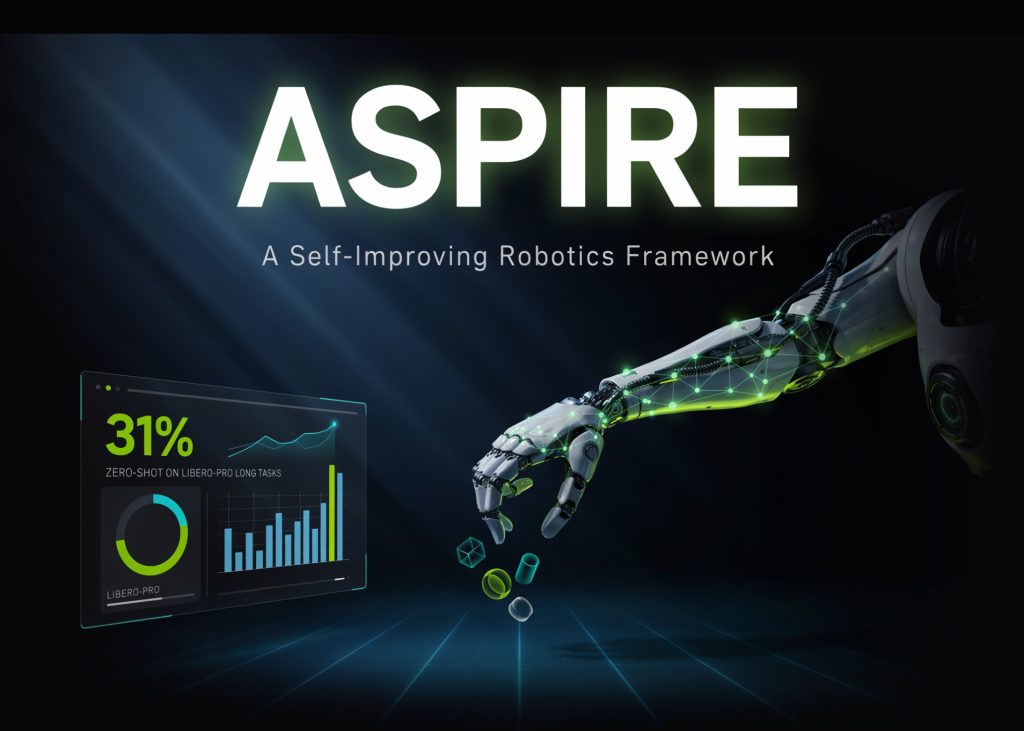
NVIDIA introduced ASPIRE, a self-improving robotics framework that reaches 31% zero-shot performance on LIBERO-Pro long-horizon manipulation tasks — a benchmark aimed at generalization to unseen, multi-step robot tasks. The framework fits NVIDIA's broader robotics and 'physical AI' push (Isaac, GR00T, NeMo RL), extending its dominance from data-center training into embodied agents.
The technical pitch is self-improvement: rather than relying solely on human demonstrations, ASPIRE iterates on its own experience to improve long-horizon task success, which is where most robot-learning systems fall down. A 31% zero-shot figure is modest in absolute terms but notable for unseen long tasks, where prior methods often score in the single digits.
The backdrop is NVIDIA's staggering financial position — roughly 75% gross margins and about $49 billion in quarterly free cash flow — as a projected $750 billion AI-infrastructure spending wave lifts chip and data-center demand. NVIDIA is simultaneously reshaping how AI clouds procure compute via revenue-sharing infrastructure deals (see separate item).
Caveats: LIBERO-Pro is a simulation/benchmark setting, and sim-to-real transfer remains the hard part for robotics; 31% zero-shot is a research milestone, not a shipping product. What to watch: real-robot results, whether ASPIRE ships inside Isaac/GR00T tooling, and adoption by robotics startups building on NVIDIA's stack.