Armada raises $230M at $2B valuation for portable AI data centers
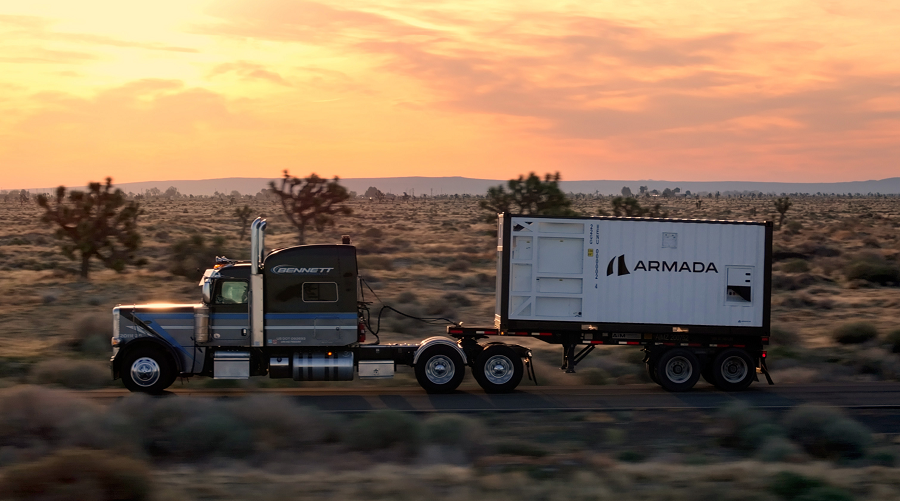
Armada's raise lands in the same week as the Google–Blackstone $25B JV and Zyphra's $500M AMD-only training push — a cluster of capital flowing into anything that disintermediates the centralized Nvidia/hyperscaler model. Armada's pitch is specifically about edge AI: containerized portable data centers paired with satellite internet software, deployable to remote industrial sites, defense forward operating areas, disaster-response zones, and maritime/energy installations.
Mechanically, Armada's product packages compute (typically GPU-accelerated), power, cooling, and connectivity into shippable units that can be operational within days of arrival. The satellite-internet software layer — presumably Starlink-compatible — is what makes it viable for environments without terrestrial fiber. The customer mix implied by Johnson Controls and 8090 Industries' participation skews industrial and energy.
Competitive context: the broader edge-AI infrastructure narrative gained credibility through 2025 as inference workloads (vision, robotics, agentic monitoring) increasingly need low latency to local data and intermittent or no central connectivity. Armada is the most credible US challenger to traditional containerized-DC vendors that haven't repackaged for AI workloads.
Skeptical takes: $2B valuation on $230M raised is on the rich side for an infrastructure capex business, and the AI-at-the-edge thesis has historically been broader in PR than in revenue. Inference workloads that truly require edge deployment versus hub-and-spoke remain a niche — though a growing one. Watch for named defense and energy customer deployments, gross margin disclosure as units scale, and whether Armada partners with NVIDIA on Verified Agent Skills or with OpenAI on Dell-style on-prem channel agreements.