Mistral Makes Chinese GLM 5.3 the Default in Vibe Code, Sparking Independence Debate
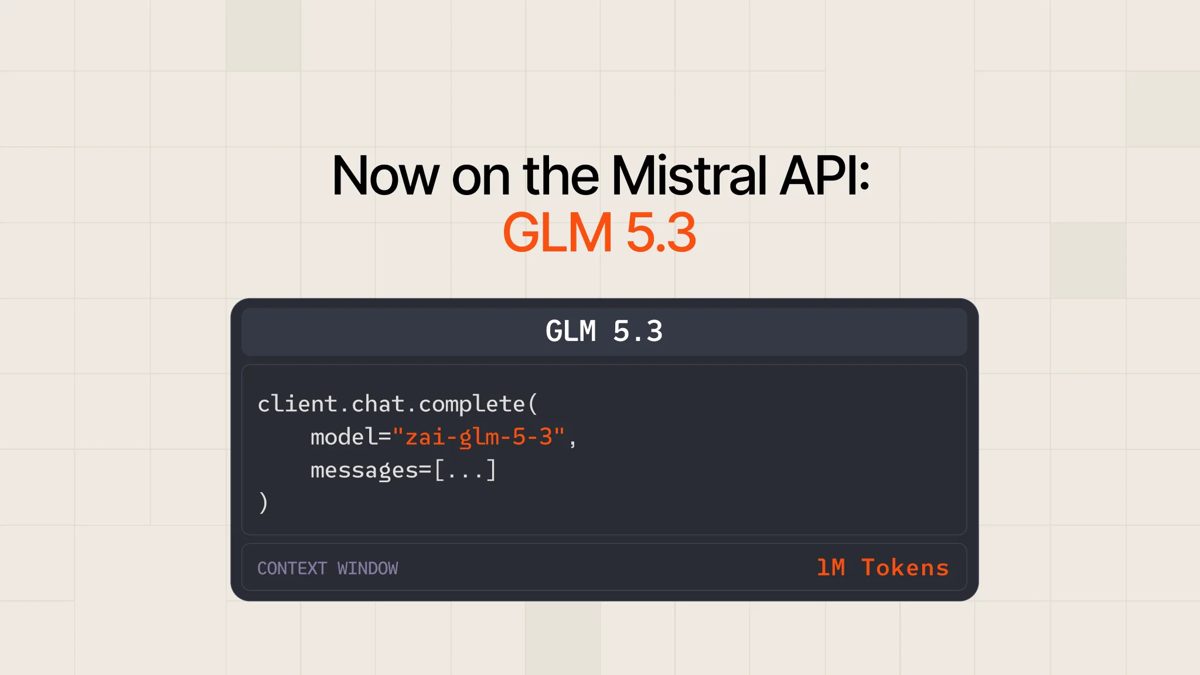
Mistral has made a surprising choice in its Vibe Code assistant: the Chinese-origin GLM 5.3 model from Z.ai is now the default, displacing Mistral's own Medium 3.5 and Large 3. GLM 5.3 brings a 1-million-token context window, 100+ tokens/second throughput, a 99.5% uptime SLA, and a 90% price drop on cached input for repeated prompts—a compelling cost/performance package for coding workloads.
The decision is pragmatic on the merits: for high-context coding, GLM 5.3's throughput, context, and cached pricing outclass Mistral's current lineup, and defaulting to the best available model serves users. But it lands awkwardly against Mistral's brand identity as Europe's sovereign-AI champion. Making a Chinese model the default in a flagship product invites exactly the 'renouncement' critique that French coverage (next.ink) flagged.
The community split accordingly: some called it a sensible cost/performance call and evidence Mistral is user-first rather than dogmatic; others saw it as undercutting the European-independence positioning that is central to Mistral's regulatory and investor narrative. CEO Arthur Mensch's separate framing—that 'AI apocalypse = regulatory capture'—resonated with some as principled and struck others as self-serving, feeding a broader debate about Mistral's strategic coherence.
Competitively, the move highlights how the open/efficient tier is increasingly dominated by Chinese labs—GLM, DeepSeek, Qwen—forcing even a national-champion Western lab to build on their models to stay cost-competitive. For Mistral, the risk is reputational: sovereignty is its differentiator with European enterprises and governments, and defaulting to GLM 5.3 hands critics an easy line. Watch whether Mistral reverts to its own models as they improve, or leans further into being a neutral orchestration layer.