AWS Unveils Random Network Graph (RNG) Datacenter Network Design
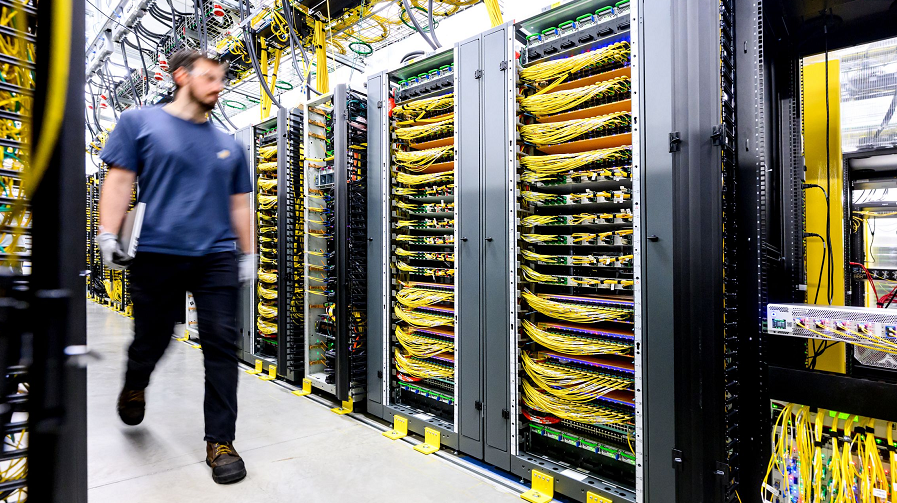
AWS detailed Random Network Graph (RNG), a new datacenter network architecture that abandons traditional Clos topologies in favour of a randomised graph fabric. AWS claims significant throughput and reliability gains, anchored on a power-free fiber-optic cable management system and a custom protocol tuned for the bursty all-to-all traffic patterns typical of large training and agentic inference workloads.
The technical pitch is that RNG provides more uniform path diversity and reduces hot-spotting compared to fat-tree designs, while the passive cable management cuts a failure mode that has bitten hyperscalers as port counts climbed into the hundreds of thousands per site. AWS is positioning RNG as a structural advantage as it scales Trainium and the new generation of Nvidia Vera Rubin deployments.
Competitive context: Microsoft and Google have both pushed custom optical fabrics, and Meta has talked publicly about its own RoCE-based fabric for Llama training. RNG is AWS's most detailed public networking disclosure in years and lands the same week it deepened the Anthropic alliance — both are pieces of a broader bet that AI economics will be decided by infra efficiency, not model leaderboards.
Watch: independent throughput benchmarks, and whether RNG ships to Outposts or stays AWS-region-only.