Anthropic's Claude produces first computer-checked proof of Fermat's Last Theorem
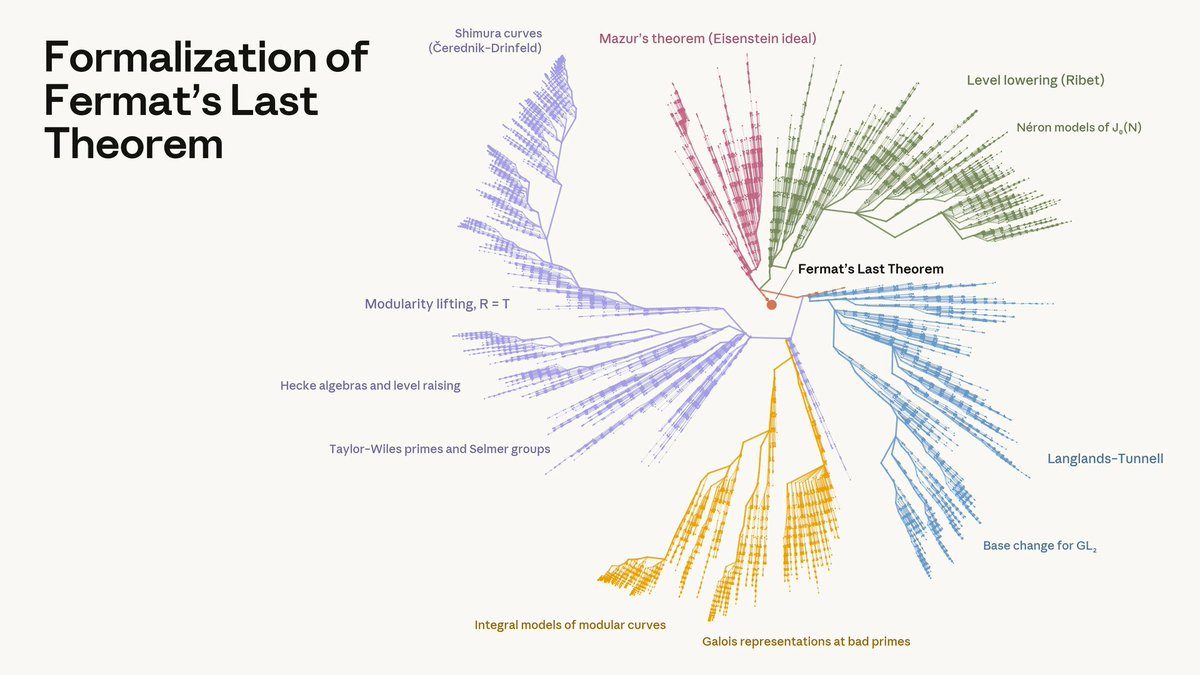
Anthropic announced that, last month, Claude completed the first formalized, computer-checked proof of Fermat's Last Theorem, one of mathematics' most famous problems. Formalization — converting mathematical reasoning into a form that proof assistants like Lean can mechanically verify — is notoriously labor-intensive; checking a major proof's correctness can take human experts years. Anthropic reports Claude worked autonomously for 11 days, generating roughly 13 million lines of Lean code and verifying about 29,500 intermediate theorems, following a simplified route based on Andrew Wiles's landmark proof.
The significance is less about 'discovering' new mathematics — the proof strategy is known — and more about demonstrating sustained, long-horizon autonomous reasoning with a hard, external correctness oracle. Because Lean mechanically checks every step, the result is verifiable in a way that free-form LLM 'reasoning' is not: either the proof compiles or it doesn't. That makes it a credible signal of progress on multi-day agentic tasks where errors compound, exactly the regime frontier labs are racing to master.
The announcement (11,881 likes, 1,562 retweets on Anthropic's post) landed amid a busy competitive week and served as Anthropic's counter-narrative to OpenAI's GPT-6 Astra launch. Skeptics will note the proof followed an existing human roadmap rather than finding novel results, and that formalization of already-proven theorems is a constrained domain. Still, for the formal-methods community it is a landmark demonstration, and it hints at near-term uses in verifying software, cryptographic protocols, and safety-critical systems where machine-checkable guarantees matter more than raw fluency.