Google launches Gemma 4 12B, an encoder-free multimodal model that runs locally on a 16GB laptop
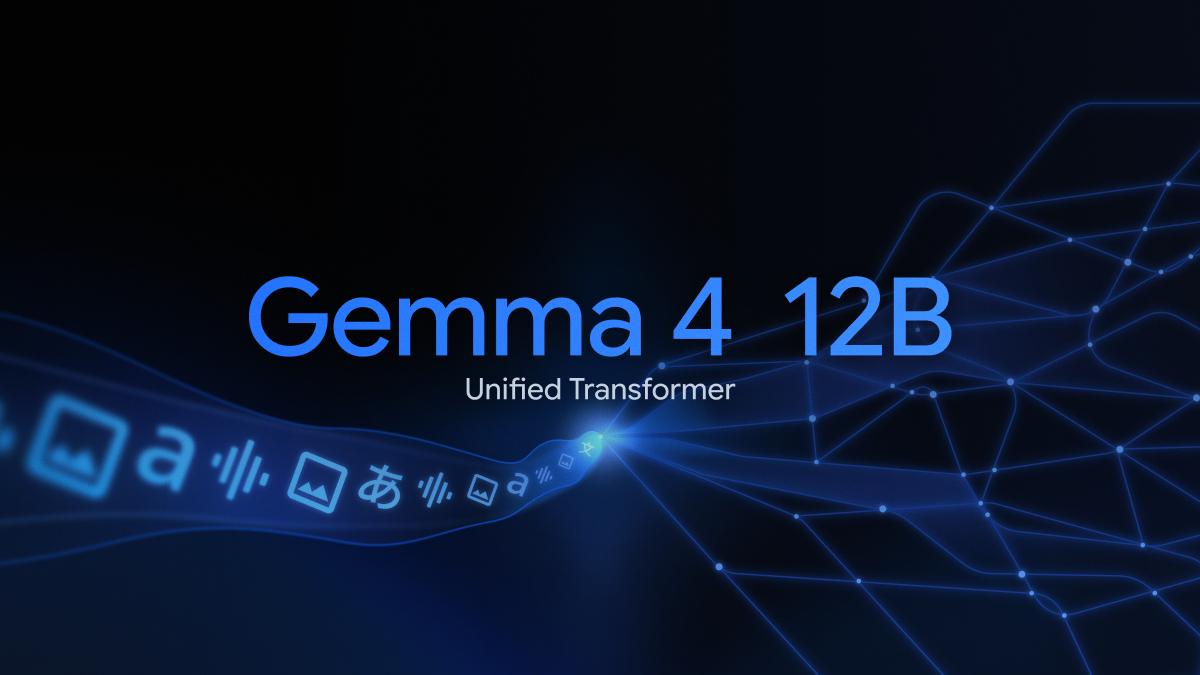
Google released Gemma 4 12B, a 11.95-billion-parameter open-weights model under a permissive Apache 2.0 license, optimized to run entirely locally on a typical enterprise laptop using just 16GB of VRAM or unified memory. It topped Hacker News at 1,018 points and 382 comments, and Sundar Pichai pitched it as hitting 'a sweet spot between size and performance.'
The key innovation is an encoder-free 'Unified' architecture. Traditional multimodal systems use separate encoders to translate audio and visual data into representations the language model can read, adding latency and memory overhead. Gemma 4 instead lets raw audio waveforms and visual patches flow directly into the core LLM backbone, packing a 256K-token context window, native agentic tool use, and an explicit step-by-step reasoning mode into a compact footprint.
Strategically, Google is bucking the bigger-is-better trend, betting on the surging local-AI movement: offline use on flights, privacy-sensitive deployments, and zero per-token cost. It shipped immediately on Hugging Face and Kaggle, and Google brought AI Edge Gallery to macOS so Mac users can run Gemma models locally — directly competing with NVIDIA's RTX Spark and Intel/Perplexity on-device pushes.
The caveat surfaced almost immediately: a remote code execution flaw in Hugging Face Transformers — the very runtime many will use to load these weights — underscored ML supply-chain risk. And while developers cheered the encoder-free design on HN, the open question is whether a 12B local model is 'good enough' for real agentic work or merely a convenient fallback to cloud frontier models.