Meta's Brain2Qwerty v2 reads text from brain activity without surgery
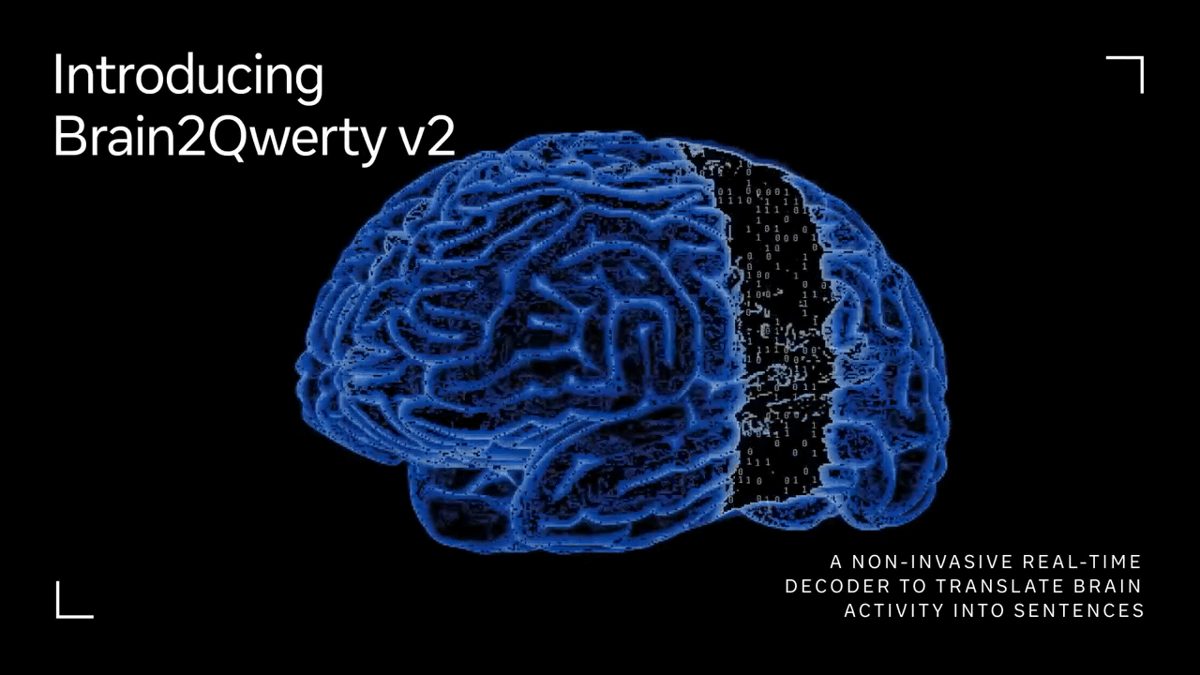
Meta announced Brain2Qwerty v2, its latest effort to translate noisy brain activity into coherent text without invasive surgery. Building on v1 (published in Nature Neuroscience and released February 2025), v2 moves from decoding characters one at a time to reading at the word and sentence level, using non-invasive magnetoencephalography (MEG) instead of surgically implanted electrodes.
The model was trained on roughly 22,000 text data points from nine volunteers, each typing for 10 hours while their brain's magnetic field was measured. Brain2Qwerty v2 achieves a 69% character-recognition success rate and up to 78% word-recognition accuracy — with the best-performing subjects recognizing more than half of an entire text with one word or less of error, approaching the accuracy of invasive methods.
The goal is to help people with paralyzing neurological conditions communicate via thought, bypassing risky neuroprosthetic implants. Meta open-sourced the code for both v2 and its predecessor to accelerate neuroscience research, a notable move given Meta's recent debates over open-source strategy.
Caveats are significant: MEG scanners are large, expensive, non-portable machines, so this is a research advance rather than a consumer product. Accuracy also varies substantially across subjects and requires extensive per-user training data. Still, closing the gap with invasive electrodes using a non-surgical method is a meaningful milestone, and the open-sourcing invites independent replication and extension by the broader neuroscience community.